Monday, August 30, 2010

Jumping Kick 101

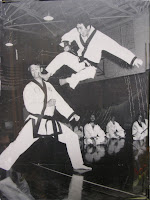
Jumping front kicks are powerful martial arts kicks that look cool. The difference between a front kick and a jumping front kick, is that the jumping front kick will allow the martial artist to reach much higher with the same amount of force

Find an open space, about 3 square metres
Balance yourself with one foot about half a metre behind the other, the back foot facing the left or right, depending on what foot it is. This should create a "L" shape with both feet 

Bring your back foot up to about waist high, and in one movement spring up with your front foot, bringing your back foot forward, and then scissor it back, moving your front foot forward and snapping your leg out with your toes pulled back 
At the end of performing this kick, your back leg should touch the ground firstIt is very helpful to stretch before performing this kick, as you can pull a muscle very easily if you do not  
Once you have got the hang of this kick, try doing it faster until the kick is one fluid motion
To get your kick even higher, bring your back leg up higher before you jump. The higher your back leg is, the higher your kick will reach

Do not use this in any situation where your life is in danger.

Make sure your toes are pulled back, because if they are not, and you hit something solid, you will cause a lot of damage to your toes


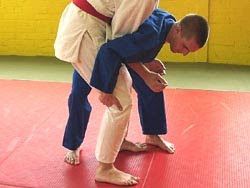
Escape From Full Nelson

Tuesday, August 24, 2010

Self-Defense Weapons: A Comparative Look


Self-Defense Weapons:
A Comparative Look

By Meghan Gardner
Let's discuss weapons.
We all know the basic three: Pepper/Mace Spray, Stun Gun (Electric Shock) and Hand Gun.
Each of these is either banned, heavily restricted, or requires Firearm ID to legally carry in many states. Be sure that if you carry or own any weapon that it is legal in your state!
There are also "nuisance products" which either emit high, piercing sounds or, upon activation, dowse the potential victim with a foul smelling ointment (in an effort to make the victim less "appealing").
First I will reiterate that which cannot be overstated: Any Weapon You Wield, Carry, or Own Can Be Used Against You! Now an analysis of each weapon type.
SPRAYS:
Pepper Spray (Oleoresin of Capsicum) usually comes in strengths of 5-10%. May cause eye closure, skin irritation and shortness of breath for several minutes. Mace contains CN Tear Gas which may cause tearing and eye closure for several minutes. Either can contain such additives as dyes (visible or ultraviolet) for identification of attacker, and/or a foaming agent which causes the spray to expand rapidly upon impact into a sticky foam which may further inhibit the attacker's sight and/or breathing.
Advantages: Non-Lethal. Easily Concealed. Disabling attacker's eyes may prohibit pursuit. Dye may aid in attacker apprehension.
Disadvantages: Limited Range (generally 10-15 ft., depending on model). Limited Target (must hit attacker in face). Small percentage of population not affected by spray. Adrenaline or even sheer determination may postpone or inhibit affects of spray. DO NOT discharge into wind.
STUN GUNS:
Device delivers electric shock upon contact with skin. May cause confusion, weakness, disorientation, loss of balance and muscle control for several minutes. Some have a wrist strap that disarms unit if separated from strap. Requires batteries. Available in various voltage levels (normally 65,000 - 125,000).
Advantages: Non-Lethal. Effective anywhere on body.
Disadvantages: Range - must make physical contact with assailant.
HANDGUNS:
Various sizes/models (9mm, .38, .44, etc.). Each caliber differs in "stopping power", recoil, conceal ability (size/weight), number of rounds contained in single load/magazine. Requires permit in every state. Concealment or carrying while loaded illegal in some states.
Advantages: Intimidation Factor - sometimes just the sight of a gun is enough to halt an attack. Range (depending upon shooter's ability). May be more effective against multiple attackers.
Disadvantages: Constitutes Lethal Force. Requires regular training to become proficient in accuracy beyond 15 ft. Risk of accidental firing and/or innocent bystander getting shot. Takes time to draw, aim and fire. Requires regular maintenance. Expense. They may also be lethal if taken away and turned against you.
NUISANCE PRODUCTS:
Personal Alarms activate by switch or separation of strap and emit loud, high decibel (100 dB) sound. Stench Ointments are contained in a small breakable vial that when broken, dowse the wearer with powerful smelling chemical. Usually comes with neutralizing chemical.
Advantages: Non-Lethal. Purchase and use are not restricted in any states.
Disadvantages: Not physically damaging. Willful intentions on part of attacker can easily nullify effect.

There are also various forms of kubotons/keychains (small bars made of metal or plastic that are held in the fist). Be careful - any extruding parts could be classified as "Brass Knuckles" which are illegal in many states. As well, many airports will not allow you to carry these on the plane.
Makeshift weapons include: Hair Picks; Pencil/Pen; Keys; Hot Coffee/Tea; Hair spray; Steering Wheel Locks; Dirt; Rocks; Sticks; Loose Change; Pots & Pans; Bottles; Chair/Stool; Golf Club; Shovel; Hair Pin; Roll of Quarters; Hand Weights; Pool Cue; Camera; Rolled-Up Magazine; Eyeliner; Umbrella; Briefcase; Purse; Toothbrush...and I could go on ad nauseam....
If it is has a point - thrust it at them. If it is long - swing it at them. If it is flat - use it as a shield. For everything else - throw it at them. Even a teddy bear in the face gives you a moment of surprise.
But always remember - the most effective weapon of all is Your Brain! Utilize your environment.
And do not hesitate - take your advantage and either Run or Fight! With every ounce of strength you have. Use your fear and anger. We have all heard about the 90 lb. mom who lifted the overturned automobile to allow her child to crawl out to safety. It isn't a miracle - it's called adrenaline. It's the beast that resides within us all. But you first must unleash it.

Defeating The Headlock


From a neurological viewpoint you are attacking the hypoglossal nerve at approximately an inch forward from the angle of the jaw (before the jaw turns upward toward the ear). This is where the nerve connects to the back end of the tongue. The best way to activate this point is quickly to penetrate with the thumb tip upward toward the top of the skull. When done properly the technique can cause acute pain and momentarily stun the opponent.


Modern schools of the Kōga tradition


  • Koga Ryu Wada Ha; originally taught by Fujita Seiko, the 14th headmaster of Koka-ryu Wada-ha ninjutsu who was a martial artist instructor at the Nakano spy school during World War II.[1]
  • Kagetora Budo Kai; is a "Gendai Ninjutsu" school with lineage and some relationship to the "Way of theWind" of Ronald Duncan (Wada Ha) & the Banke Shinobiden of Jinchi Kawakami. This school specialised in tactics and weapons aplications of the historical Koga (Koka) ninjutsu 
  • Banke Shinobinoden group; Jinichi Kawakami and his top student Yasushi Kiyomoto, who claim to be the last practitioners of Banda-Ha Koga Ryu Ninjutsu, teach Koka and Iga ninjutsu in Japan.

Arts of the Kōga


The Kōga ninja practiced similar arts as their Iga counterparts. The Kōga had separated the arts so they could practice solely on what was needed for certain situations. Instead of mixing all the teachings, separating them 
allowed them to focus, yet they used them together in a lethal combination.

  • ninja
  • Angou: Signaling
  • Bajutsu: Horsemanship art
  • Bōjutsu: Staff art
  • Boryaku: Military strategy
  • Chimon: Geography
  • Choho: Espionage
  • Gokui atemi sakkatsuho zukai: Secret killing strikes art
  • Goton-no-jutsu: Five elements escape methods
  • Kukushi bukijutsu: Hidden weapons art
  • Hensōjutsu: Camouflage art
  • Hichojutsu: Jumping art
  • Hojōjutsu: Rope tying art
  • Hojutsu: Gunpowder and fire art
  • Kusarigamajutsu: Kusarigama art
  • Kyushojutsu: Vital points art
  • Iaijutsu: Sword drawing art
  • Intonjutsu: Escaping and concealment art
  • Jōjutsu: Short staff art
  • Jouhou kaishuu: Information gathering
  • Karumijutsu: Body lightening art
  • Kenjutsu: Sword art
  • Kyuba: Mounted archery
  • Kyujutsu: Archery art
  • Naginatajutsu: Naginata art
  • Shinobi-irijutsu: Stealth and entering methods art
  • Seishin teki kyoko: Spiritual refinement
  • Shurikenjutsu: Throwing weapon art
  • Sojutsu: Spear art
  • Suijutsu: Swimming art
  • Suirenjutsu: Water survival art
  • Taihenjutsu: Body moving art
  • Taijutsu: Body fighting art
  • Tenmon: Meteorology
  • Zanshin: Clear mental awareness

Modern history (1800 to present) of martial arts

The systems of Japanese martial arts that post-date the Meiji Restoration are known as gendai budō. The most well known of these arts includejudo, kendo, some schools of iaidō, and aikido. The Western interest in East Asian Martial arts dates back to the late 19th century, due to the increase in trade between America with China and Japan. European martial arts before that time was focussed on the duelling sword among the upper classes on one hand, and various styles of folk wrestling among the lower classes on the other.
Edward William Barton-Wright, a railway engineer who had studied Jujutsu while working in Japan between 1894–97, was the first man known to have taught Asian martial arts in Europe. He also founded an eclectic martial arts style named Bartitsu which combined jujutsu, judo, boxing, savate and stick fighting. Also during the late 19th century and early 20th century, catch wrestling contests became immensely popular in Europe.
The development of Brazilian Jiu-Jitsu from the early 20th century is a good example of the worldwide cross-pollination and syncretism of martial arts traditions.
During pre-war and World War Two shows the practicality of martial arts in the modern world and were used by Japanese, US, Nepalese (Gurkha) commandos as well as Resistance groups, such as in the Philippines, (see Raid at Los Baños) but not so excessively or at all for common soldiers.
The later 1970s and 1980s witnessed an increased media interest in the martial arts, thanks in part to Asian and Hollywood martial arts movies and very popular television shows like "Kung Fu", "Martial Law" and "The Green Hornet" that incorporated martial arts moments or themes. Following Bruce Lee, both Jackie Chan and Jet Li are prominent movie figures who have been responsible for promoting Chinese martial arts in recent years.